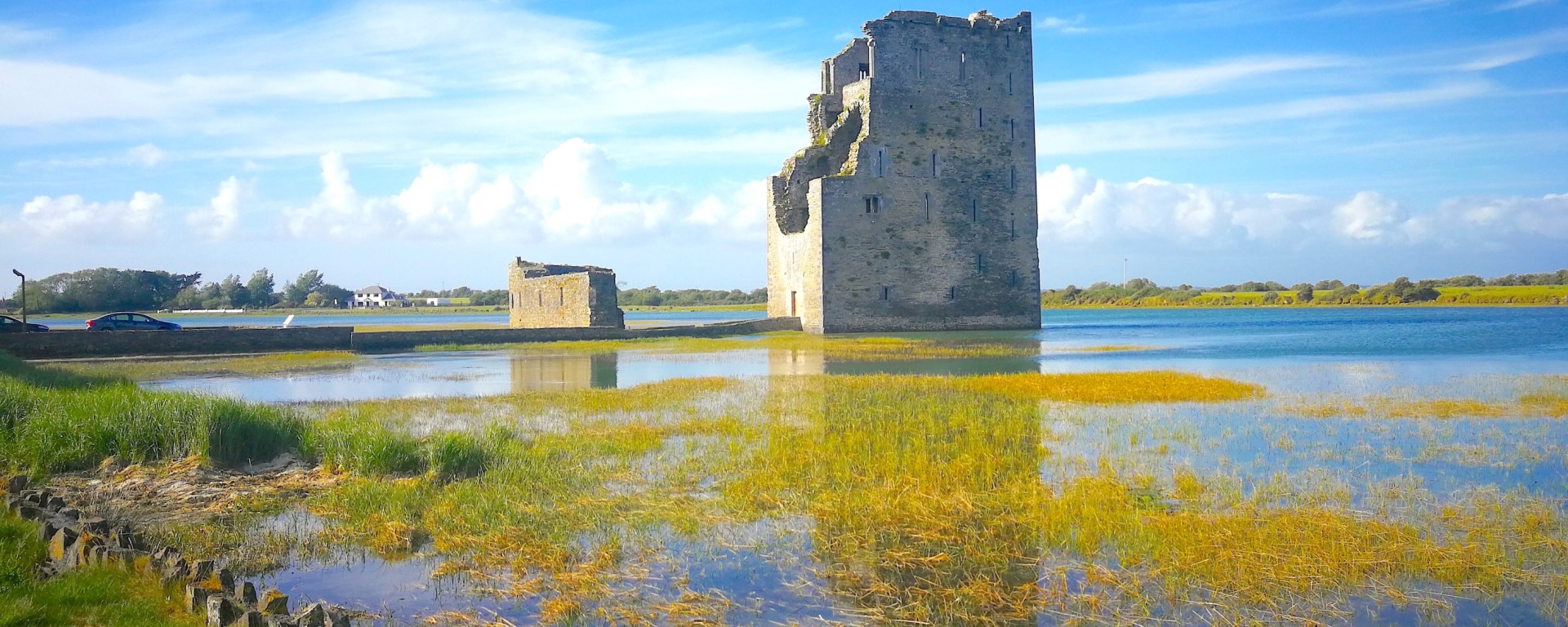
Carrigafoyle Castle, Ballylongford, Co.Kerry
Watch Video of Carrigafoyle Castle
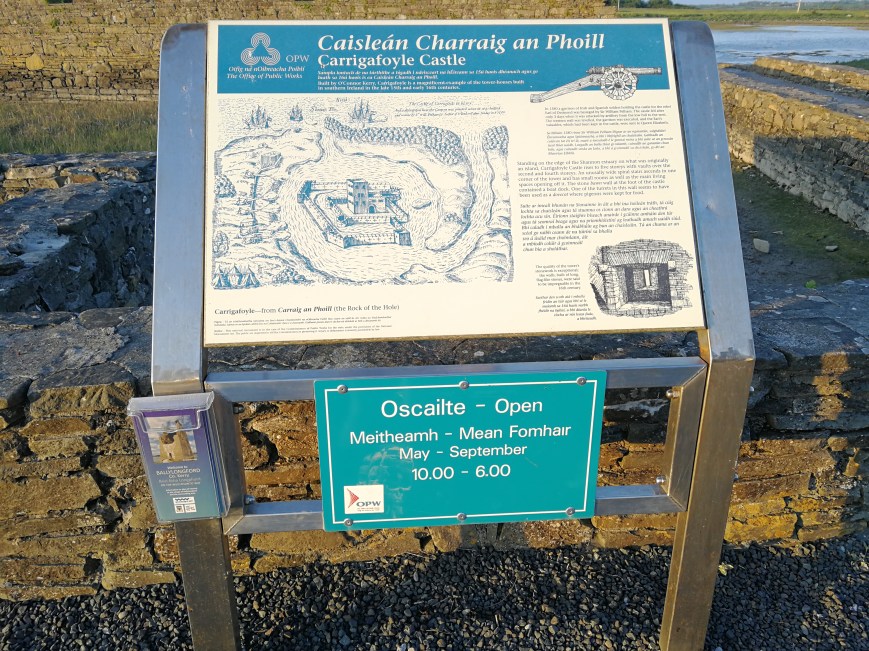
Carrigafoyle Castle, Ballylongford, Co.Kerry
Carrigafoyle Castle
The very name of this castle derives from the old Gaelic description of its foundations – ‘the rock with the chasm’. What survives today of the original fortress bears impressive testimony to the wealth and power of Cornelius (Conor Liath) O’Connor-Kerry, who had it built during the 1480s and 90s. He and his wife had also commissioned the exquisite Lislaughtin Cross. While the Renaissance was flourishing in continental Europe during the 15th century, Gaelic and Gaelicised-Norman Ireland was undergoing a major economic and cultural boom known as ‘the Gaelic Revival’. This great castle with its central keep or tower (five storeys high with 104 internal steps leading to the solarium at the top), and its inner and outer curtain walls and bastions is one of the finest examples of Irish architecture of that period. However, it has a most unique feature in that it had a fortified harbour within its walls. Similar features may be seen in Lisbon’s Torre de Belém on the Tagus estuary. From here, the O’Connor- Kerry galley fleets patrolled the Shannon estuary, and provided escorts to the merchants trading in and out of Limerick, Askeaton and Tarbert in return for fees and tributes in wine. On Palm Sunday, 1580, the castle fell to Queen Elizabeth I’s forces commanded by Sir William Pelham. The entire garrison of Irish and Spanish soldiers under the command of Captain San Julián, was hanged from the battlements. Later in 1605, King James I restored the O’Connor-Kerry to his castle and some of his estates, though most of his lands had already been granted to Trinity College Dublin in 1592. In 1652, the fortunes of the O’Connor- Kerry lordship ended when Cromwellian troops destroyed the castle, and executed its lord, John O’Connor-Kerry, in Tralee’s market square.
The Castle is opened to the public in the summer months from first Friday in May to September
10.00 AM – 6.00 PM
Martara Brooch 7th Century
The Martara Brooch was discovered by Mrs Sheila Edgeworth in July 2009 cleaning out the ashes from her range at her home in Martara. The brooch was thrown into the fire the night before concealed in a sod of turf cut from the family’s bog in Tullahennel North, Ballylongford, Co.Kerry but miraculously survived.
The Brooch can be seen in The Kerry Museum in Tralee, Co.Kerry.

Ballylongford Wetlands
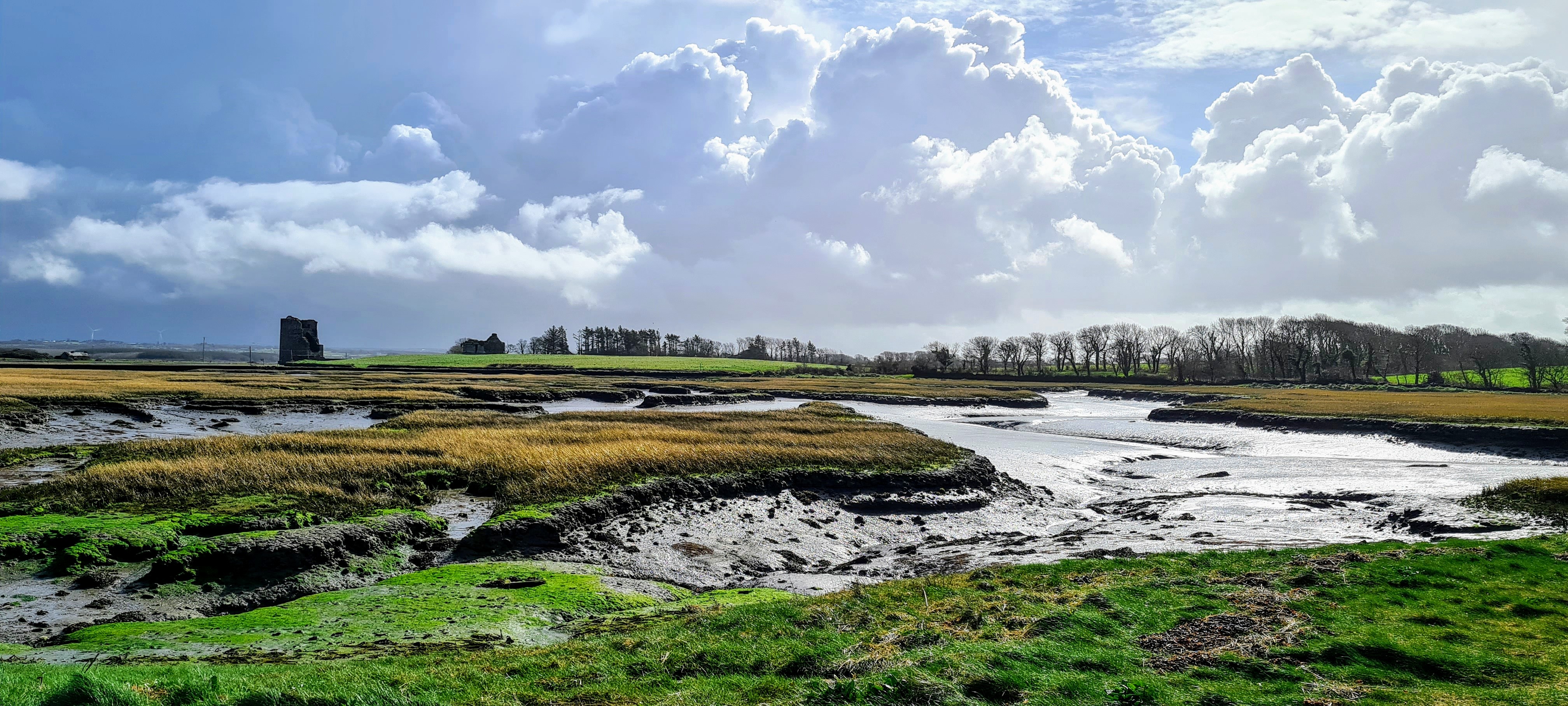
Ballylongford Wetlands, Ballylongford, Co.Kerry
Ballylongford Bay Wetlands is considered internationally important for its Birdlife. The natural deposition of silt from water courses has created vast expanses of mudflats and coastal wetlands of national importance. In the winter months the estuary comes alive with thousands of migrating birds who feed on these mudflats. Ducks, swans, divers, grebes, geese and waders stop here on their journey south escaping the harsh northern winter. A further 16 species feed here in numbers that make the estuary nationally important for their populations. Species like Cormorant and Whooper Swan and ducks such as Shelduck, Wigeon and Teal while waders such as Lapwing, Bar-tailed Godwit, Curlew and Greenshank are all frequent visitors. In excess of 50,000 birds are recorded visiting the Shannon estuary in the winter months.Many of these birds are protected which is why Ballylongford is a Special Protection Area (SPA) and is also a Special Area of Conservation (SAC)
An account of Biodiversity in Ballylongford during the winter of
2023-2024.
Once a month from October 2023 to March 2024 we (Helen Lane from the Ballylongford Tidy Towns / Volunteer and Bird Watch Ireland Member.) and (NPWS Conservation Ranger Sean O’Brien/NPWS staff) conducted bird surveys in Ballylongford town and in the Ballylongford wetlands to monitor the population of wintering waterbirds in the area.
Birds were the main focus of these surveys but many other animal groups and a great variety of plants and fungi can be found among Ballylongford’s myriad of natural habitats.
These surveys were done as part of the Irish Wetlands Bird Survey monitoring programme (I-WeBS), which is a national survey effort co- ordinated by Birdwatch Ireland and funded by the National Parks and Wildlife Service. Across the country a range of volunteers, Birdwatch Ireland staff and NPWS staff conduct these surveys to monitor and research Irelands population of wintering waterbirds.
The hinterland of Ballylongford contains a wide variety of wetlands habitats which host a dazzling array of flora and fauna. The word wetland is a general term which refers to any of a wide variety of habitats that are either wholly inundated by water such as lakes and rivers, to habitats of waterlogged soils such as bogs and marshes, to tidal habitats like estuaries and marshes, to habitats that are often dry but get covered in water at certain times of year such as turloughs and river floodplains.
Wetlands are important habitats that are a cradle for many forms of life and they are highly productive. The wetland habitats of Ballylongford include the estuary of the Ballyline river, which connects to the much larger estuary of the river Shannon. An estuary is a habitat where one or more rivers meet the sea. The freshwater of the river and salty sea combine into an area of brackish water, this is the estuary. Estuaries transitional zones where two types of ecological communities meet and blend into a unique and diverse set off flora and fauna. When the tide is high the brackish waters flood the estuary, and when the tide is low the waters retreat and expose a vast area of mudflats. Mudflats, also known here in Ireland as slobs are formed by the deposition of sand, mud and silt. The twists and turns of the Ballylongford Estuary, and the bulwark that is Carrig Island protect these mudflats from the erosive power of the sea, enabling the sediment to settle. Mudflats teem with a myriad of invertebrates, such as crabs which scuttle along their shores and bury themselves, periwinkles which slither slowly hovering up algae, ragworm which burrow in mud in search for tiny invertebrate prey or food to scavenge, lugworms which filter debris and food out of the sand and mud and much more. These invertebrates which are often out of sight make tasty snacks for much of Ballylongford’s bird life. The Bar-tailed Godwits, Black-tailed Godwits, and Curlew etc. will probe their long beaks into the mud in search of the worms in particular which they busily feed upon with relish when the tide is out.
There are a myriad of waders which visit Ballylongford Wetlands in the winter time, many of them have different shaped beaks which are adapted to foraging for different foods in different conditions. So even though they are all in the same area feeding together they don’t compete for the same resources. The Redshank, may appear like any other wader with its mottled greyish brown feathers and paler underbelly, but if you get a good view in clear light you can see that it has a bright orange- reddish bill and legs which add a lovely dash of colour on a walk along the roads of Carrig Island, which is just North West of the town. Another bird to keep an eye out for is the Greenshank, which is slightly bigger than the Redshank and with a longer but darker grey bill, more brown upper feathers and pale greenish grey-yellow legs.
Like the Redshank the beak of the Oystercatcher is a bright orange red, but it is much larger and broader than other waders and is designed for cracking open the shells. Oystercatchers will also use their bill to probe into soft mud. They can be found foraging in Ballylongford Wetlands when the tide is out or roosting on rocky shores when the tide is in.
Ballylongford Wetlands also hosts the magnificent spectacle of vast flocks of Lapwings and Golden Plovers. These birds can be seen foraging in shallow water or in fields near the sea. When they take flight they often do so in huge flocks flitting gracefully back and forth while calling gently. Their dazzling murmurations are one of Ireland’s great nature spectacles. A keen observer may also spot a few Grey Plovers, a scarcer relative of the Golden Plover which comes down from the high arctic.
When the tide is high one might spot a Grey Seal peering its head above the water or see some of the famous Shanon Estuary Dolphins breaching the water as they play or hunt for fish.
There are many piscivorous waterbirds that dive for fish in the flooded Ballylongford Wetlands at high tide. In winter time finding them is not a matter of luck, but of patience. If you scan out over open water long enough you are nearly sure to see the regal and sleek Great-Crested- Grebe resting in between dives to catch a breath. These birds are have dark plumage above and pale plumage below, and they have an elegant head crest which they wear on their crown like a fancy hairdo. During the nesting season their crest grows in bright colours along the sides of their head like shaggy sideburns. In late autumn some of the Grebes to be found in Ballylongford may still retain their breeding finery. The same is true of the Great Northern Diver, known in America as the ‘Common Loon’ due to its haunting and beautiful courtship call. These graceful birds in their summer plumage have glossy black feathers with iridescent white patches. In winter they become more drab and camouflaged but are still beautiful to look at. Great Northern Divers are quite large and impressive birds and can often be seen scoffing down a fish or a crab before gently slipping back into the water in pursuit of more food.
A smaller and cuter cousin of the Great Crested Grebe can also be found in Ballylongford Wetlands, the Little Grebe. These birds are small. Even fully grown Little Grebes look like the chicks of some other bird species. Hence their other common name, the dab-chick. However, they are not to be underestimated as they are excellent divers and flyers and can easily evade danger, they are also expert hunters of aquatic invertebrates, small fish and will feed on many things opportunistically. Like many of Ballylongford waterbirds they are very colourful, with glossy black feathers and touch of red on their cheeks and throat.
During winter months in and amongst the salt marshes of Ballylongford you are sure to find Teal. These diminutive ducks are a resident species in Ireland, and like to nest on inland wetlands. Our resident birds are also joined by visitors from abroad that find Ballylongford Wetlands and other Irish Wetlands ideal places where there is ample food and shelter.
If you find yourself longing for the colours of the flowers of spring and tire of the drabness of winter, go find a Teal to look at. The males have a dazzling array of colour they wear a mixture of russet orange, glamorous green, sliver and black stripes and a touch of white here and there. The females like many other duck species are a drabber, because they are sensible and seek to avoid danger, but they will bear a single patch of green on the brown feathers too. It is common among many duck species for the males to be brighter coloured than the females. This is also true for the familiar Mallard another species Wigeon, both of which are also to be found in Ballylongford Wetlands. Indeed Wigeon flock to Ballylongford Wetlands in their hundreds, their large rafts are quite a spectacle to behold.
Large numbers of Brent Geese also visit Ballylongford. These are winter visitors that come all the way from Canada or Svalbard to wait out the winter in Irelands mild climate. They find plenty of food foraging in muddy estuaries like Ballylongford Wetlands, or grazing in open green spaces. These small and dark coloured geese often roam in large groups and are beloved by many people with a dedicated study group (The Irish Brent Goose Research Group) monitoring them. Keep an eye out for colour rings on these geese that when looked up can give a fascinating glimpse into the life of the bird. Places like Ballylongford Wetlands are very important for this species.
Another waterfowl found commonly in Ballylongford is the Shelduck. These are dazzlingly colour birds, they have a crimson red beak, bright white feathers decorated with patches of russet brown and regal black. Unlike many other ducks both males and females share the overall same bright colour scheme, albeit the females are slightly smaller and their colours are just a tad more faded. Many of our shelduck fly in during the winter from Scandinavia or the Baltics, but we do have some that are resident as well.
In addition to its famous wetlands, there are many other habitats around Ballylongford as well. In winter the farmland around Ballylongford host groups of Whooper Swans. The most usual type of swan you might see is the Mute Swan, which is resident on many of our lakes, rivers and ponds. Indeed you might find a few of these in Ballylongford as well. But Whooper Swan is a visitor from Iceland, one difference between these species is that the Mute Swan has a bright orange beak, whereas the Whoopers Swan beak is yellow. They are fond of large open agricultural fields in which they graze during the day. These fields are often safe places for them with plentiful food where predators can be easily seen and avoided. They can look quite humorous as they stumble about awkwardly on the ground, but when they take flight they are most serene and graceful and boast an impressive wingspan of up to 2.4 metres!
The urban area of the town itself is home to many common garden birds that reside in horticultural areas and gardens, as well as birds often found in urban habitats such as jackdaws, rooks, starlings and house sparrows that nest on buildings or forage in built up areas.
Ballylongford is also a historical town of great significance, from which gave rise to figures such as “The O’Rahilly” and Brendan Kennelly to name just a few. Ballylongford has a number of beautiful and ancient man made structures. One of these is Carrigafoyle Castle which was built in the late 1490’s by the O’Connor Clan to project their power over the Shannon Estuary. Structures such as these can provide great habitat for some wildlife such as Swallows which nested in the castle in the summer prior to the survey period and Pigeons which regularly roost in the Castle. Castles and human habitations are very similar to the cliffside habitat of the Rock Dove, which is the wild ancestor of the Feral Pigeon, and so Pigeons often favour these sorts of places.
Woodland Habitats
Another type of habitat that can be found in the vicinity of Ballylongford are Woodland Habitats which include small groves of woodland, ancient tree lines, hedgerows. These habitats are very important Wildlife corridors that provide connectivity for a variety of species. Bats hunt and commute to and from roosts along hedgerows. Wildflowers and flowering shrubs often thrive in hedgerows, providing essential nectar and pollen for bees, butterflies, and other pollinators. Many species of birds rely on hedgerows and tree lines as a source of food, shelter and for nesting.
Overall waterbirds were the main target of the surveys that were conducted over the winter, but there were many other living things that were not recorded. Ballylongford is host to a multitude of plant species, including species that are typically only found on the coast. Many of these coastal plants are especially adapted to living on the coast and have waxy leaves to prevent water loss from being coated in salt or from drying out in hot weather. Examples include Common Scurvy Grass, Sea Rocket, Sea Beet and Sea Aster. The Wildflowers in the coasts, Farmland and Hedgerows around Ballylongford provide ample food for a variety of Butterflies, Bees, Hoverflies and other Pollinators.
The sheer variety and number of Waterbirds and other Living Things to be found in Ballylongford are a testament to how Valuable and Important the Ballylongford Wetlands and Habitats around the town of Ballylongford are.
Birds at Ballylongford Wetlands
October 2023 to March 2024
1 Bar-tailed Godwit
2 Black-tailed Godwit
3 Oyster Catcher
4 Curlew
5 Redshank
6 Greenshank
7 Lapwings
8 Golden Plover
9 Grey Plover
10 Great Crested Grebe
11 Great Northern Diver
12 Little Grebe
13 Teal
14 Mallard
15 Wigeon
16 Shelducks
17 Little Egret
18 Herring Gull
19 Lesser Black Gull
20 Peregrine
21 Heron
22 Pintail
23 Turnstone
24 Whimbrel
25 Ringed Plover
26 Dunlin
27 Cormorant
28 Black headed Gull
29 Kestrel
30 Chough
31 Great Black Backed Gull 32 Shags
33 Whooper Swan
34 Whooper Juvenile Swan 35 Snipe
36 Brent Geese
37 Common Gull
38 Common Sandpiper
39 Knots
40 Juvenile Herring Gull
 Ballylongford Snaps